No products in the cart.
BRIDAL JEWELLERY’ of Spiti – A visual treat of a Hinterland
BRIDAL JEWELLERY of Spiti – A Visual Treat of a Hinterland
Introduction
Hidden deep within the cold desert mountains of Himachal Pradesh lies Spiti Valley, a land where culture, heritage, and craftsmanship breathe in every stone and snowflake. The region is not just a traveler’s paradise but also a treasure trove of ancient Himalayan artistry—especially its bridal jewellery. The Bridal Jewellery of Spiti is a visual spectacle—grand, meaningful, spiritual, and deeply rooted in the Tibetan-Himalayan identity of the valley.
This blog takes you on a captivating journey through the unique designs, cultural symbolism, materials, and ceremonial significance of Spiti’s bridal adornments. With traditions unchanged for centuries, each jewellery piece narrates a story of lineage, blessings, values, and the rugged beauty of this hinterland.
BRIDAL JEWELLERY of Spiti – A Visual Treat of a Hinterland
1. The Cultural Soul of Spiti’s Bridal Jewellery
Bridal jewellery in Spiti isn’t merely ornamental. It reflects:
- Ancestral heritage
- Social identity
- Connection with Tibetan Buddhist culture
- Protection against evil energies
- Blessings for prosperity and fertility
These adornments have been passed down through generations, making them family heirlooms rather than fashion accessories.
BRIDAL JEWELLERY of Spiti – A Visual Treat of a Hinterland
2. Materials Used: The Himalayan Touch
The jewellery of Spiti is crafted from elements found in the harsh Himalayan terrains, Buddhist trade routes, and ancient barter exchanges.
Common Materials Include:
- Turquoise (Feroza) – symbol of purity & good luck
- Coral (Moonga) – represents protection & vitality
- Silver – the prime metal of all ornaments
- Ambar/Amber – believed to hold healing properties
- Himalayan pearls
- Yak bone (in some traditional pieces)
The colors—deep red, vibrant turquoise, earthy golden—form a distinct palette that immediately identifies Spiti jewellery anywhere in the world.
3. The Iconic Bridal Jewels of Spiti
Let’s explore the timeless masterpieces worn by Spitian brides.
3.1 Perak – The Crown of Honour
: “Perak Head Ornament of Spiti”

The most recognizable ornament in Spiti, the Perak is a long, turquoise-studded headpiece that drapes from the bride’s forehead to her back.
It symbolizes:
- Royalty of the lineage
- Blessings of ancestors
- Protection from negative energies
Each turquoise stone is believed to carry ancestral spirit, passed down from mother to daughter.
3.2 Choktsa – The Traditional Necklace
The Choktsa is a chunky, multilayered necklace made from large beads of coral and turquoise. It rests prominently over the bride’s chest, symbolizing:
- Wealth of the family
- Health & fertility
- Divine blessings for prosperity
The bright coral-red beads beautifully contrast the cold desert backdrop of Spiti.
3.3 Serkhang Jewellery – The Golden Glow
Though gold is rare in Spiti, brides often wear Serkhang, gold-plated silver ornaments gifted by families during marriage. These may include:
- Earrings
- Bracelets
- Finger rings
- Amulets
Each piece is engraved with Buddhist motifs—the endless knot, lotus, or dorje—reflecting spiritual purity.
3.4 Patang – The Bridal Belt
The Patang is a wide, heavy belt made of silver and beads, worn around the waist. This signifies:
- Stability in marriage
- Strength and responsibility
- Protection of feminine energy
It also holds the bride’s attire together, adding regal charm to the ensemble.
3.5 Bokh – The Wedding Shawl Adornment
A Spiti bride drapes a traditional woolen shawl or Bokh, decorated with:
- Mirrors
- Embroidered borders
- Silver pins
- Colorful beads
This shawl is often gifted by the groom’s family, making it a symbol of acceptance and unity.
4. The Spiritual Significance of Bridal Jewellery
Every ornament worn by the bride during the wedding holds profound Buddhist symbolism.
For instance:
- Turquoise represents the sky and spiritual awakening.
- Coral represents blood, life, and protection.
- Silver represents the moon, purity, and calmness.
The jewellery is blessed by monks, ensuring that the bride steps into her new life with peace, purity, and positivity.
5. The Process of Making Spiti Bridal Jewellery
The jewellery-making process is a skill passed down through families of local artisans.
Steps Include:
- Collecting raw stones from Himalayan traders
- Hand-polishing turquoise and coral
- Shaping silver using traditional tools
- Engraving religious motifs
- Crafting beads and assembling multilayered chains
- Embedding stones into Perak or choktsa frames
This slow, intricate process may take weeks or even months, highlighting the immense craftsmanship behind each ornament.
“Artisan Crafting Traditional Jewellery in Spiti”
6. Modern Influence With Traditional Heart
While young brides may occasionally blend modern touches with their attire—lighter versions of choktsa, redesigned earrings, or minimal perak—the essence of the jewellery remains untouched.
The modern adaptations focus on:
- Lightweight designs
- Refinement for daily wear
- Tourist-friendly jewellery sets
- Contemporary styling of traditional pieces
This fusion keeps the heritage alive while adapting to today’s generation.
7. Why Spiti Bridal Jewellery Is a Visual Treat
The combination of vibrant colors, rich gemstones, ancient craftsmanship, spiritual meaning, and rugged mountain aesthetics makes Spiti jewellery nothing short of a visual feast.
Imagine:
- A bride wrapped in the ancient charm of the Silk Route
- Turquoise stones glistening under the Himalayan sun
- Coral beads adding warmth against the cold desert
- Silver ornaments shining like moonlit snow
It is raw, divine, majestic, and deeply cultural—a true reflection of Spiti Valley’s soul.
8. Preservation of Spiti’s Jewellery Heritage
With modernization touching even the remotest corners, preserving Spiti’s jewellery traditions is crucial.
Local communities and cultural groups are now:
- Training young artisans
- Reviving ancient jewellery designs
- Organizing fairs & exhibitions
- Promoting sustainable tourism
- Documenting the heritage digitally
This ensures that the identity of Spiti lives forever through its jewellery.
Conclusion
The Bridal Jewellery of Spiti is not just an adornment—it is a story of history, spirituality, craftsmanship, and cultural pride. Every bead, stone, and silver carving reflects the strength of the mountains and the purity of Spiti’s traditions. As the world modernizes, these jewels stand tall as living reminders of an ancient Himalayan civilization.
Celebrate Spiti, celebrate its brides, and celebrate the breathtaking legacy that continues to shine through its timeless jewellery.
BRIDAL JEWELLERY’ of Spiti – A visual treat of a Hinterland
An innate desire of humans is to look beautiful and that’s why jewellery was invented. Surprisingly, it was not the ‘Homo sapiens’ but the ‘Neanderthals’ who first used jewels to beautify themselves around 130,000 years ago – imagine! Early on jewelry was made of shells, bones, and stones but later metals took over with gold and silver becoming the preferred choice.
BRIDAL JEWELLERY’ of Spiti – A visual treat of a Hinterland
BRIDAL JEWELLERY of Spiti – A Visual Treat of a Hinterland
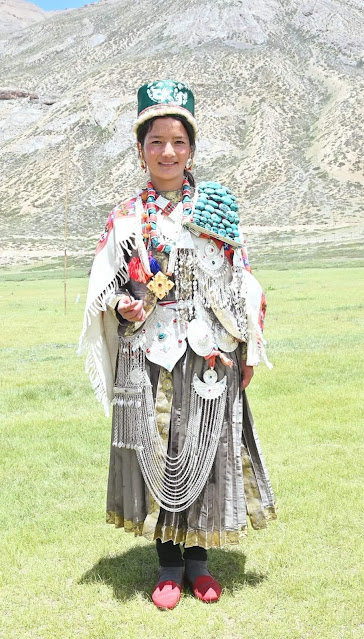
A Spiti woman in the traditional dress and Jewellery – Photo credit Ajay Banyal
Did you know that initially jewellery was worn more as amulets to ward off evil eyes and to secure garments? As most dresses were wrapped around, they required securing. With time, jewels took on an ornamental quality and became immensely treasured. Men were equally enamored, and jewels adorned both genders the world over in all cultures.
Jewellery is a valuable archaeological source as well, signifying a lot of things— the wearer’s personality, status, and wealth; the richness of their culture along with their traditional and religious beliefs. Sometimes it can tell the story of trade or geographical resources.
Women of Spiti
BRIDAL JEWELLERY of Spiti – A Visual Treat of a Hinterland
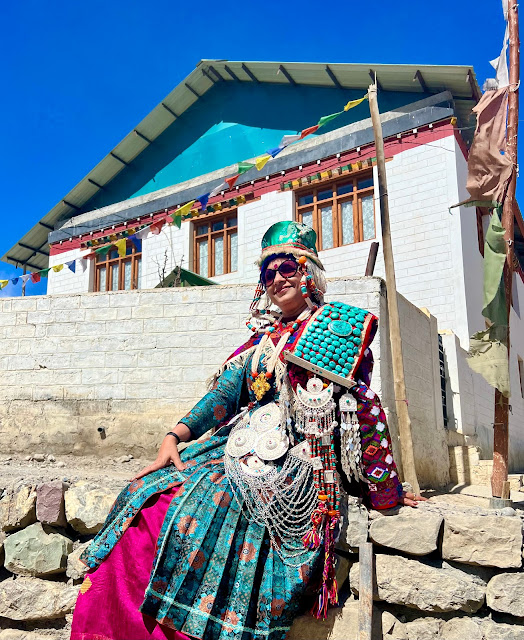
With Kesang Rapchik and Dolma – At their beautiful home
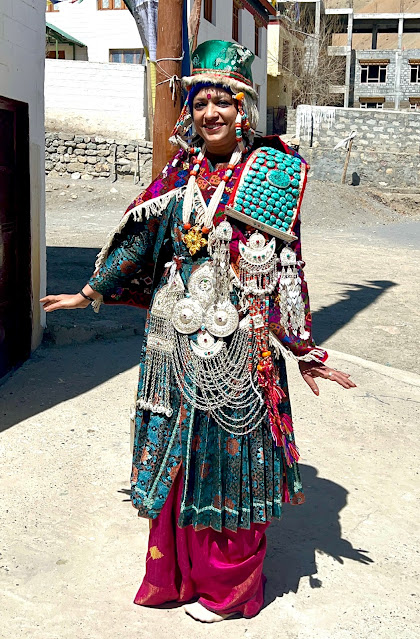
Wearing the entire Bridal set of jewelry with their Shamo (cap), Rigoya (the dress), and Lingti (woven shawl)
Spiti jewelry is similar to Kinnaur, Lahaul, and Leh and is mainly made of silver with many precious and semi-precious stones – turquoise, coral, and pearls. The tribal jewelry is influenced by Tibetan designs that have been preserved through the ages. The pieces are heavy and worn covering head to waist, and nothing on the feet due to climatic conditions. The Spitian women also don’t pierce their noses and wear any nose jewelry.
Mostly designed to secure the traditional dress, especially the shawls, and to cover the head and ears to protect against the cold. Interestingly the ear flaps of the headgear (Perak) were added after one of the queens of Spiti developed an ear infection and required protection from the cold winds!
Berag – The most precious item made of silver, cloth, and sapphire to cover the head
The torquise were earlier bought from Tibet and were very expensive but now artificial Torquise is also available and it reduces the cost of Berag.

Kondha – Earings-silver with turquoise and coral beads

Ghiyun– the gold pendant – with semi-precious stones – the number of Ghiyun and their size and weight increases depending on the financial status of the family – quite similar to Kinnauri Jewellery
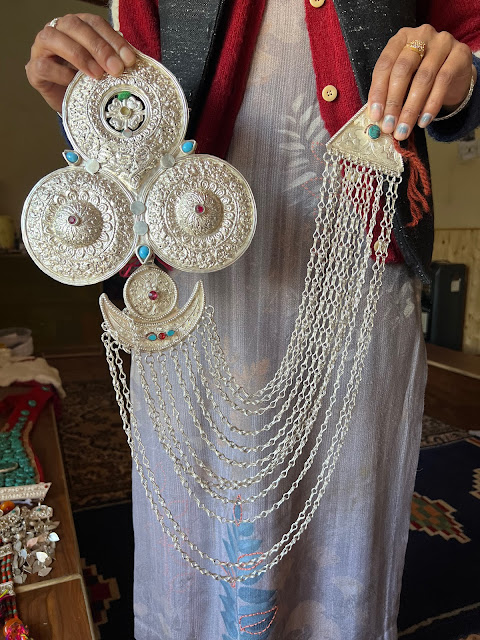
Pitsup – Waistband
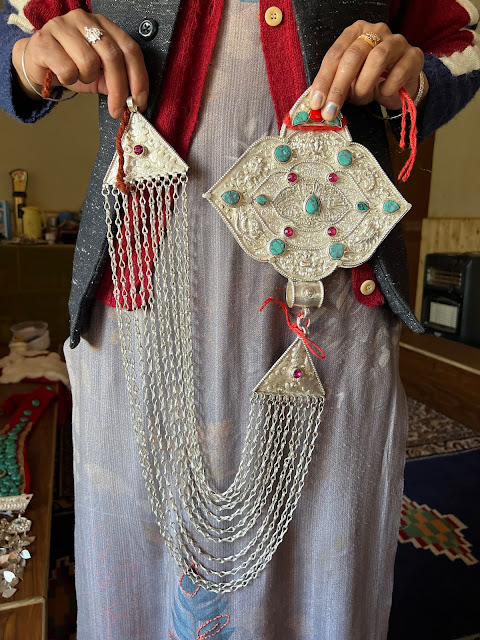
Digra – Waist belt holder
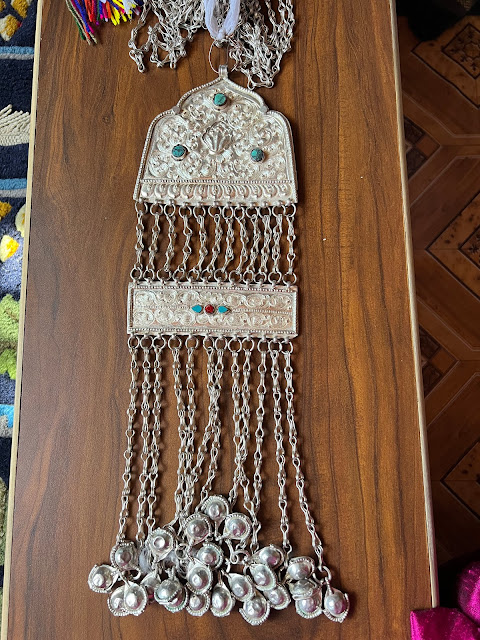
Docha – A waist ornament to be tied on the waist belt (Kira) above the right knee
Jewellery holds a special place in the lives of the women of Spiti. I could feel the pride and love Dolma had for her jewelry in the way she explained them to me. There are also many customs attached to jewelry in their culture.
The head ornaments like Berag and Perak are not worn by unmarried women. The young girls wear simple jewelry; heavy and elaborate jewelry is only for married women.
In older times only ‘Khangchen’ homes (the high noble families) and not the ‘Khing Chung’ homes (the low-class families) could afford the entire Berag set with real Turquoise from Tibet. Nowadays, most women that desire a full set of bridal jewelry get it made.
The jewelry is gifted by the bride’s parents and the boy’s side does not gift jewelry to their daughters-in-law (though these traditions have become more relaxed now). It’s like pooling the resources in the new marriage – the bride brings jewelry and the boy his lands. The traditional jewelry passes from the mother to the eldest daughter only.
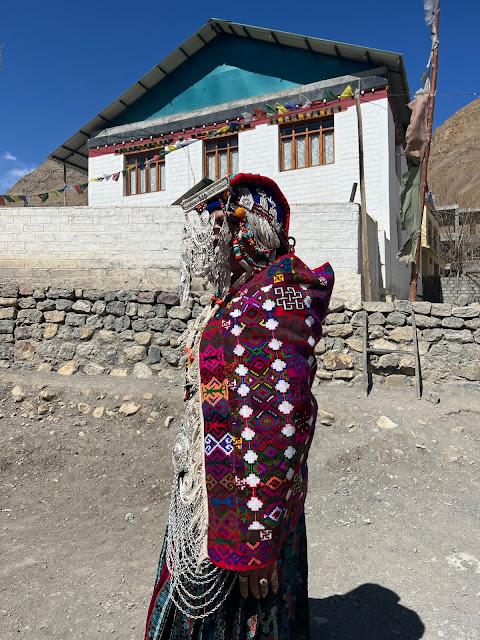
With the traditional Shawl Lingti
If a couple has more than one daughter they make new jewellery for her. The husband can add to his wife’s jewelry after marriage, which can be gifted to anyone the couple decides upon. If the couple has no daughter, then the jewelry can be gifted to either the DIL or to the nieces of the lady or the Monastery.
Interestingly, the Spitian bride covers her face only during her wedding and never before or after. On enquiring, I was told that as the groom doesn’t go to bring his bride home; hence she covers her face to be only shown to her husband on reaching her ‘sasural’ (in-laws’ home). The Bride covers her face with Berag and hardly can see through it. Married women wear it over their left shoulder.
The entire jewelry set is extremely heavy (10-12 kg, costing approximately INR 12 -15 lakh in today’s value) and one wonders how the bride bears the weight during her wedding and after! Traditional jewelry is worn on all auspicious occasions, be it religious or festive.
A bride covers her face and a married woman wears the Berag on her shoulders
The Spitian women have a simple day -to day wear jewelry as well -like Ghyool – for young girls, Chimkut -a hair ornament, Ultik – a necklace made of different beads, bracelets of shells, Doo– bangles of solid silver, and Surundup – silver finger rings.
Other than gold and silver no other metal is used in the Tribal jewellery of HP – which is unlike the rest of India. Probably because the upper regions of Himachal had close trade ties with Tibet and the tribals had enough resources for jewellery befitting their social status. Perhaps it was also a way to invest their surplus money.
Most of the jewelry is crafted by the two local jewelers in summer and who migrate to Kinnaur during winter. This kind of jewellery is available in Kinnaur also but most Spitians get it made in Kaza only.
With the loving family of Rapchik and Dolma
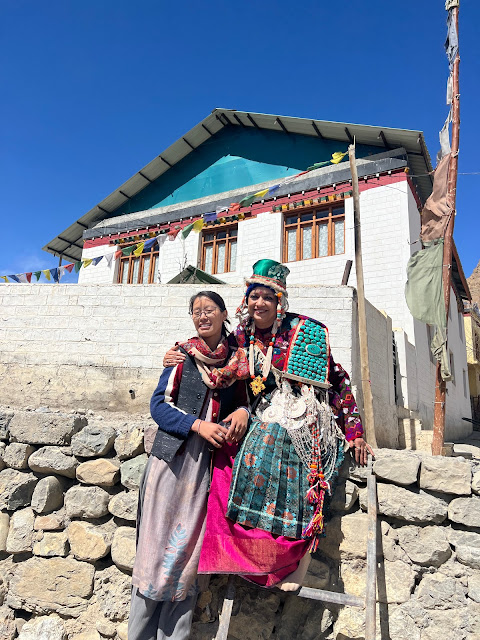
Personally, I was delighted to dress up as a Bride again after 32 years! So fascinated I was with my bejeweled look, that I ordered some jewelry for myself and my daughters from the local jeweler. Thank you to Dolma and her aunts for all the love and affection and pampering they showered on me. More than the jewellery it is their generosity that captured my heart.